Knowing your uric acid levels is vital to managing your gout.
Your doctor should be testing you every few months – more frequently if you have started a new treatment, changed gout diet, or made some other change that might affect your uric acid level.
If you do not know the amount of uric acid in your blood (often called serum uric acid), make sure you arrange for a test today. And get the exact number – not an opinion such as high, normal or low. Often, uric acid test results are described as normal when they are at a dangerous level for gout sufferers.
One complication of the results is that different testers use two different measurements. Conventional measurements are mg/dL, which is the most common. Some countries, especially in Europe, have adopted SI units which are either mmol/L or more commonly ?mol/L (pronounced mewmol per liter or litre).
Uric Acid Levels Guidelines
For complete reference information about all aspects of uric acid levels, including: normal uric acid levels; uric acid range; uric acid scale; and uric acid level chart, please see:
- Uric Acid Level
- Your uric acid level is vital to help you fix your gout. But when you start checking you see it fluctuate. Don’t worry – just look for a healthy range.
- Uric Acid Test Kit
- A uric acid test kit is easy to use, yet provides vital information on your uric acid levels. It helps you stay in control of your gout, but don’t even think of buying one without reading these guidelines.
- Uric Acid Levels
- Ignore uric acid levels that are high, low, or normal. You need to think is it safe or dangerous. Get uric acid levels facts now.
- Uric Acid Level Charts
- This uric acid levels chart extends the mini uric acid table in the right-hand sidebar on every page. See the uric acid scales by safe, OK, warning, and danger.
- Uric Acid Level Ranges
- Uric acid levels numbers are key to controlling gout. So why does everyone get uric acid ranges wrong? See the exact numbers backed by real science. Get uric acid ranges facts now.
- Uric Acid Concentration
- What does mg/dL, mmol/L etc mean? Use this uric acid calculator for easy conversion between different scales.
- Normal Uric Acid Levels
- See why you should avoid normal uric acid. Avoid using normal for uric acid levels, as it is widely misused and dangerous for gout control.
- High Uric Acid Levels
- Though we know that elevated uric acid is one of the main symptoms of gout. How high is too high? See why you have to have your own personal target for high uric acid levels.
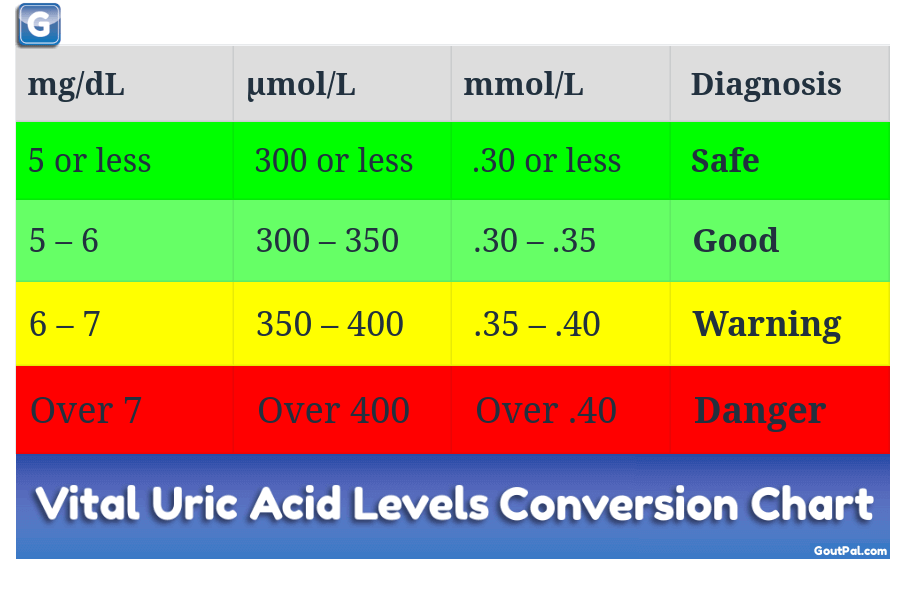
Please remember that interpretation of your uric acid level test results should be done by a qualified medical practitioner, preferably a rheumatologist. You might consider supporting these “official” tests with your own interim uric acid level tests at home.
A couple of points from recent discussions:
Also, please note that the levels stated are for people who have had a gout attack (gouties). Some people have higher than normal levels, yet never form the crystals that cause gout. This is known as asymptomatic hyperuricemia.
I prefer a simpler definition.
Gout Virgins have never had a gout attack. Their uric acid level is considered normal in the 2.4 – 8.2 mg/dL range.
Gouties have uric acid crystals in their joints and tissues that will trigger more gout attacks at much lower levels. Hence the Warning and Danger levels.
This How often do I check Uric Acid Levels? question is now in the gout forum.
You can now use a uric acid calculator to convert between mg/dL and mmol/L
I wonder how do you test your acid uric level? Do I have to go to the lab ? Can we do at home ? Thank you.
As I wrote in uric acid level tests at home, you can get a home test kit. However, gout is always controlled best when it is treated by a partnership of you and your doctor, therefore I always advise that you draw up a good testing plan with your doctor. Test at least once per year if you have ever had a gout attack – more frequently if uric acid levels are unstable through treatment changes, diet changes, or other reasons.
If you cannot get a good plan with your doctor, home test kits are good. however, you have to be meticulous in your personal test procedures to ensure proper blood droplet size. If you do not have the personality type to apply disciplined procedures, then you are better finding a local lab testing service that will test your blood for you.
I have checked uric acid level today for the first time in my life, it was 7.3, does that mean I have gouts?
I have Achilles tendinitis since a while, is that because of gouts?
sorry it was 7.6 not 7.3
I think my uric acid reading was 8.9. Very high, I know. I was having an intense pain in my foot which triggered the test. I am not overweight and do not eat a high purine diet, but do take a diuretic. I do eat well and probably overdue sugar and burgers. My chiropractor said it definitely wasn’t gout, but she saw me after the most intense pain had passed. I had three doctors look at it and none of them were convinced it was gout because it didn’t show itself in the common ways. My pain would only occur while walking. The skin was not red. Pressing on certain spots on my foot would cause pain, especially the big bone on the very top of my foot.
I did have xrays and there was no evidence of any kind of joint disease or abnormality.
I guess my question is does this sound like a gout attack or is it from ill fitting shoes?
Any info? Thanks.
Diuretics are the second biggest cause of gout after genetics. If diuretics are for blood pressure, there are many alternatives that do not have the well known uric acid increasing of some. If your doctor fixes this, chances are that the uric acid levels will drop to 5 without any further intervention. If not, allopurinol will do it. A rheumatologist is the best doctor for gout that is difficult to diagnose or difficult to treat, but a heap of commonsense also goes a long way.
For more specifics, please let me know exactly what diuretics you are taking:- exact name, exact dose, how long for. Any other meds? Any other gout history in the family. It would be better if you start a new discussion on this in the gout symptoms forum.
Forget the G P’s and see a rheumatologist who is knowledgeable re gout/uric acid and do not delay!