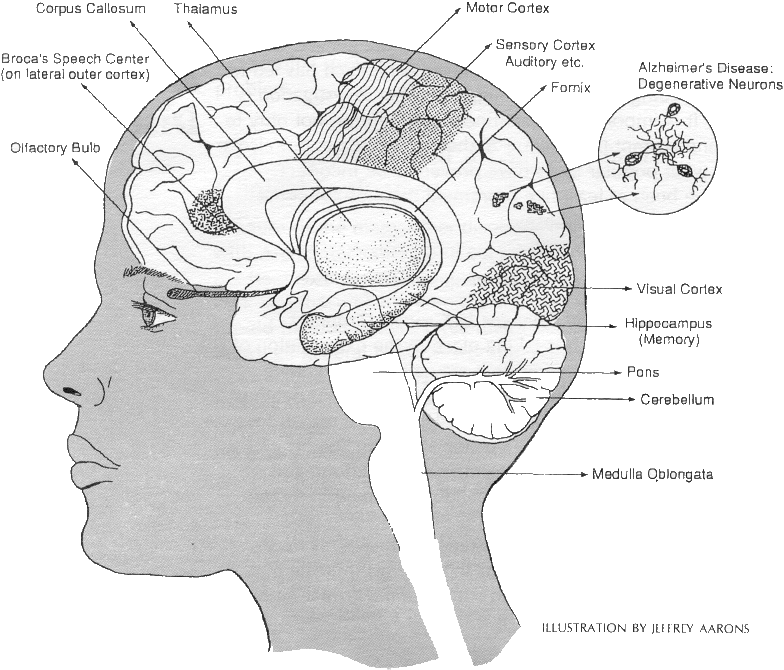
 Whilst looking for information about uric acid, I came across an interesting piece about Alzheimer’s disease and uric acid [reference to Mathilda37 removed: no longer available].
In the article, Mathilda refers to some recent research about uric acid as a potential cure for Alzheimer’s, or at least a way to hold the progression of the disease.
The research in this article follows on from a piece I did last year explaining how uric acid could reduce nerve damage. The researcher, Professor Firestein, pointed out to me that maintaining an adequate level of uric acid in the body is important.
There are a few more important points about uric acid, Alzheimer’s disease and related medical conditions and treatments.
The research reported by Mathilda also advises uric acid levels from 0.5 up to 6mg/dL. 0.5 sounds very low, and I would love to see the original research to confirm this value. The upper level for gout sufferers should be 5.5, but 6 is probably much better than most gout patients achieve.
Mathilda’s article gives a link to Neurology Reviews. I read some interesting stuff there, but could not find the original article. I did find the abstract for Inhibition of Iron-Catalyzed Oxidations by Attainable Uric Acid and Ascorbic Acid Levels: Therapeutic Implications for Alzheimer’s Disease and Late Cognitive Impairment on the Gerontology site, where you can also buy access to the full report. If you get a copy, can I have a look?
The author of the earlier report, Professor Firestein, has also produced a report summarizing Altered Uric Acid Levels and Disease States. The report does warn that many links between diseases and uric acid are not fully understood. Significantly, we do not know in most cases whether uric acid levels change as a cause or effect of an associated disease.
It is encouraging to see that some real life research is taking place into the specific links between uric acid and other diseases. I believe a fuller understanding of all the roles of uric acid in the human body can only serve gout research well in future.
If you have any insights on this, please feel free to comment.
I would really love to know if doing all the things that are bad for gout sufferers will really help banish Alzheimers.
Personally I’d try to boost my uric acid as high as I could, having a gout attack would be the point that I’d ease off. I can’t find any medical statistics to see if gout and Alzheimers are exclusive, like gout and MS. If they are, that’s a major clue in the direction of treatment. Keep up the anti-oxidants!
As an MS sufferer I found this article very interesting.
Must now pop off and see how to get the recommended daily intake.
Will post back on this blog if I notice a difference.
Any ideas? Foods that contain the necessary etc?
Pete.
I’ve not really studied this, as I look for ways to reduce uric acid.
The drugs mentioned in the report are inosine or hypoxanthine supplemented with ascorbic acid (vitamin C).
The process ought to be similar to that for gout. Start with a uric acid test ans low dose, then increase the dose with regular uric acid tests until it reaches about 6mg/dL. Anything over that will increase the gout risk, but actual gout attacks may not happen in every individual.
The main problem I anticipate is that doctors may be reluctant to prescribe these medications for purposes that they have not been licensed for.
Pete, I have MS too. Inosine is an ‘over the counter’ nutritional supplement. You could also try eating a lot of oily fish, offal, gravy, alcohol (beer is best) and caffeine, BUT NOT COFFEE. Use fructose instead of normal sugar. Avoid dairy, milk is the worst offender. Alpha lipoic acid is also being tested, as it’s a strong antioxidant that can cross the blood brain barrier. You’ll also want to keep your vitamin intake high. I take a ‘one a day’ pill for that.
Pete, my father died of early onset Alzheimer’s, and he had gout. Please feel free to contact me if you want to know more.
PL
My mother who has alzheimers was taking gingko for about a year. She got something like gout in her big toe. The doctor told her to quit using the gingko and within the year she got alzheimers. She ate a lot of bread through out her life…addicted to good bread which has uric acid in the yeast. So maybe all the uric acid was leaving her body and settling in the toe. This does not make sense. The gingko was drawing the uric acid out of the tissues where it was protecting her from alzheimers. Should i have fed her beef liver to increase her uric acid? I wish i was a scientist. Anyway…i’d like to hear about the father who had alzheimers and gout.
Well, I know that scientists do not know all the answers. At the moment, there appears to be a link between raised uric acid and lower incidence of Alzheimer’s disease, and some other diseases such as MS. A lot more investigative work is required.
On a personal level, risks are only an indication to investigate further. Any investigation can only start with proper medical examination, especially blood tests for uric acid.
It is difficult enough to get early detection of high uric acid levels for gout. As there is no general recognition (yet?) of the risks of low uric acid, early detection and management seems a long way off.
It is human nature to look for causes, and to find reasons where actions are merely coincidence. There is evidence to show that ginko has no effect on dementia. Just as there is no evidence to show that bread effects uric acid levels. It is an unfortunate fact of life that we do not have an answer yet to the reasons for dementia.
If there is a chance that raising uric acid is beneficial, then it needs to be approached in a methodical way. Regular uric acid level tests are a must. Actions to increase uric acid must be carefully planned against other health conditions and risks. Finally, the trend in increased uric acid needs to be assessed, to see if it is helping.
You do not need to be a scientist, but you must adopt a methodical approach. You also need to be philosophical enough to accept that, at this stage in human development, we have more questions than answers.
The idea of risking a debilitating illness which can actually prove fatal (if affecting heart) to cure another chronic (if nasty) one seems risky ,at the minimum.
Better that both illnesses are investigated seperately and treated so -even if they do have links.
If Gout gets more attention in the process, all to the good.
It has been neglected for too long and even the normal med for it (Allopurinol) can prove fatal a long time after it’s first use ,apparently.
I think you’ve missed the point of this, Trev.
Uric acid is known as the bad guy for gout sufferers, but the truth is that it is a very necessary part of human metabolism. There is quite a lot of evidence that low uric acid is associated with MS and Alzheimers. Therefore if one has low uric acid, and worried about the risk of these diseases, it makes sense to do the opposite of what many gout sufferers do and seek lifestyle changes that increase uric acid. As long as uric acid does not rise above 6mg/dL, there is no risk of gout.
As for your final sentence, what evidence is there that allopurinol can be dangerous in the way you suggest?
Yes, I thought you would ask 🙂 I was surprised at the etiology myself..
| have not kept the recent link but it really did say that AlloP could present problems long (years) after first use. Maybe I avoided too close a look as I might be needing it yet!!
Equally Colchicine can cause problems when used with statins.
http://www.springerlink.com/content/n2105710586603g6/
http://www.nzma.org.nz/journal/120-1265/2808/
[NB Long term use]
Quote:
Most of the patients in this review were male and in most cases, symptoms abated with laboratory abnormalities resolving within weeks of colchicine discontinuation. Muscle toxicity may occur in the absence of gastrointestinal symptoms. In our 39 patients with CK results, one case of colchicine myotoxicity was detected by laboratory monitoring, thus indicating that such safety testing does have an acceptable yield.
These cases maybe rare and specific , but worth bearing in mind.
On lifestyle change approach I agree completely- but my tendency nowadays, is to veer away from allopathic solutions as they create as many problems as they cure -and many agree with that view.
Yes, to recap- my same comment would apply to Altzheimers, escept that illness is so bad to envisage, that gout would be preferable under all conditions.
I can’t see the medical establishment buying this route, though, especially as personal variables would make SUA management a hard business -and risks of suing over malpractice high.
True, the latest news on Dual freq MRI scans could help in such management , but the expense of such a protocol would frighten even the most socialist of healthcare budget setters!
An inspiration to everyone who is affected by Alzheimer’s Disease.
Carers and patients need to be aware of anything that can improve their quality of life.
http://www.foxnews.com/story/0,2933,321590,00.html
I always knew there was a connection between arthritus and alzheimers….and gout is a form of arthritus. Please read this article about the arthritus drug enbrel curing alz in minutes.
What this means in terms of the uric acid…I’ll leave that to scientists here to figure out.
That looks like excellent news for dementia sufferers. Absolutely nothing to do with uric acid or gout, as far as I can see (except a possible link via interleukin-1), but great news anyway.